 Skip to content
Grouting Failures: Why Pinholes, Cracks & Discolouration Happen When Mixing Ratios Are Incorrect
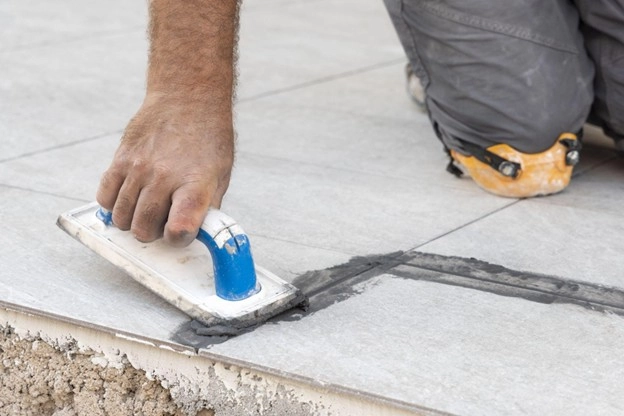
If your freshly grouted floor suddenly starts showing tiny pinholes, hairline cracks, or patchy discolouration, your first thought is probably: “Bad grout?” or “Poor installation?”
In reality, most grout failures begin long before anyone lays a trowel on the floor, at the mixing stage – especially critical for bathroom renovation projects where precision matters.
Cement-based grout is highly sensitive. Even a minor deviation – too much water, too little, mixing too fast, or remixing after slaking – can alter the chemical structure, causing visible defects later. These defects include pinholes, cracks, sandy texture, or uneven colour, and once they appear, there’s no simple fix.
In this blog, we’ll cover:
- What actually happens inside grout when the mix is wrong
- Why these chemical changes show up as pinholes, cracks, and discolouration
- How to mix grout properly to prevent these failures
Let’s dive in.
What Really Happens When You Mix Grout Incorrectly (The Chemistry Behind Every Failure)
Grout hardens through hydration, not by simple drying. Cement particles react with water to form a dense matrix of interlocking crystals. The correct water-to-powder ratio is critical – even minor deviations affect strength, colour, and durability.
- Too much water stretches the crystals, making them weak.
- Too little water leaves unhydrated cement, reducing bonding.
- Overmixing introduces air, which becomes pinholes.
- Re-tempering (adding water after slaking) resets hydration unevenly, ruining colour and uniformity.
Incorrect mixing leads to: Excess evaporation → pinholes, Shrinkage → cracks, Uneven hydration → blotchy colour, Segregation → sandy or crumbly texture – similar attention to detail is required in marble polishing to avoid surface defects.
Air bubbles created by fast mixing remain trapped until the water evaporates, showing up as pinholes. Re-tempering spreads pigment inconsistently and resets hydration cycles, producing light and dark patches.
Put simply, incorrect mixing doesn’t just reduce quality – it guarantees failure.
Why Pinholes Form When Grout Mixing Ratios Are Wrong
Pinholes are one of the earliest and most visible signs of a poor mix. They can be tiny, clustered, or scattered along grout joints.
Common Causes
- Excess water in the initial mix
Evaporates faster than hydration completes → leaving micro-voids → pinholes. - Mixing too aggressively
Air gets trapped → bubbles → pinholes. - Adding water during installation (re-tempering)
Grout loses density → low-density pockets → bubbles form when drying. - Dusty or porous surfaces
Prevents proper adhesion → more voids and pinholes.
Homeowner observations
- Tiny holes appearing within 24-48 hours
- Clustered pinholes along grout lines
- Sandy or weak texture around holes
Pinholes indicate one thing clearly: the mixture had too much air or water – attention to detail, like in full house cleaning, prevents small issues from becoming visible problems.
Why Cracks Appear When Water Ratios Are Incorrect
Cracks, often hairline but sometimes wider, usually appear due to shrinkage, poor bonding, or inconsistent curing.
Main Causes
- Excess water → shrinkage cracks
As water evaporates, grout volume reduces, creating cracks. - Too little water → brittle grout
Underhydrated grout lacks flexibility → prone to hairline cracks. - Mix inconsistencies within a batch
Different curing speeds → uneven strength → cracks. - Re-tempering
Weakens structure → double failure (structural + colour issues).
Cracks often appear when:
- The surface dries faster than the inner layer (wind, AC, heat)
- Top layer is weaker than the underlying grout
- Voids exist due to trapped air
Most cracks are hydration-related, not tile movement issues.
What Causes Discolouration When Mixing Ratios Are Incorrect
Colour inconsistency is one of the most frustrating failures because it’s immediately noticeable.
Top Causes
- Different water ratios across batches
More water = lighter colour; less water = darker colour → patchy effect. - Overwashing with sponge water
Water drags pigment → light patches, washed-out joints, or dark spots where pigment settles. - Re-tempering
Redistributes pigment unevenly → blotchy and inconsistent colour. - Hard vs soft water
Minerals affect pigment curing: soft water → slightly lighter colour, hard water → yellowish or uneven finish.
Consistency is critical. Professionals measure water, slake the mix, and use clean wash water to prevent these colour problems – the same careful approach is essential in interior painting to maintain an even finish. Without control, colour defects are almost inevitable.
How to Mix Grout Correctly to Prevent Pinholes, Cracks & Colour Issues
Here’s the professional approach:
- Measure water precisely – don’t eyeball; 1-2% difference matters.
- Add powder to water, not water to powder – ensures even dispersion and fewer clumps.
- Mix on low speed for 3-5 minutes – prevents trapped air.
- Slake for 5-10 minutes – allows proper hydration.
- Remix briefly (10-20 seconds) – just enough to loosen, not aerate.
- Use within pot life – don’t re-temper with extra water.
- Keep wash water clean – dirty water causes blotchy colour.
- Maintain consistency across batches – same water, mixing time, speed, and technique.
Grout obeys chemistry, not ‘feel’ or instinct – much like mattress cleaning, following proper steps ensures consistent and effective results every time.
The Final Word
Most grout failures – pinholes, cracks, discolouration – don’t happen at installation. They start the moment someone mismeasures, overmixes, or re-adds water.
- Too much water → shrinkage and cracks
- Too little water → brittleness
- Mixing too fast → air and pinholes
- Re-tempering → blotchy colour
Grout is unforgiving. If the chemistry is wrong, every failure that follows is inevitable.
At Clean Fanatics, we use strict manufacturer ratios, controlled mixing, and consistent batching – because strong, uniform, long-lasting grout isn’t luck; it’s precision. Get the mix right, and your grout stays solid and beautiful for years. Get it wrong, and problems start before the grout even cures.
FAQs
Trapped air or excess water from incorrect mixing causes pinholes.
Likely due to shrinkage from too much water, brittleness from too little water, or inconsistent batching.
Different water ratios, overwashing, or re-tempering the mix mid-job.
Sometimes a grout colourant helps; severe cases need re-grouting.
Follow the manufacturer’s specifications on the bag; even 1–2% variation can matter.